In the ever-evolving world of wine and grape production, research plays a crucial role in advancing knowledge, improving practices, and ensuring the sustainability of the industry. NYWGF’s commitment to research is evident in its annual research budget, which typically ranges between $350,000 and $500,000. The NYWGF Board of Directors is proud to share the results of 2025-26 funded research projects through individual reports, articles, and a series of upcoming webinars. Featured in this article are two NYWGF-funded studies:
Evaluating viticultural characteristics of new disease-resistant cultivars for New York vineyards | Principal Investigator: Hans Walter-Peterson, Senior Extension Associate, Finger Lakes Grape Program
Evaluation of Hybrid Winegrape Varieties on Long Island | Principal Investigator: Alice Wise, Sr. Issue Educator/Viticulturist, Cornell Cooperative Extension of Suffolk County
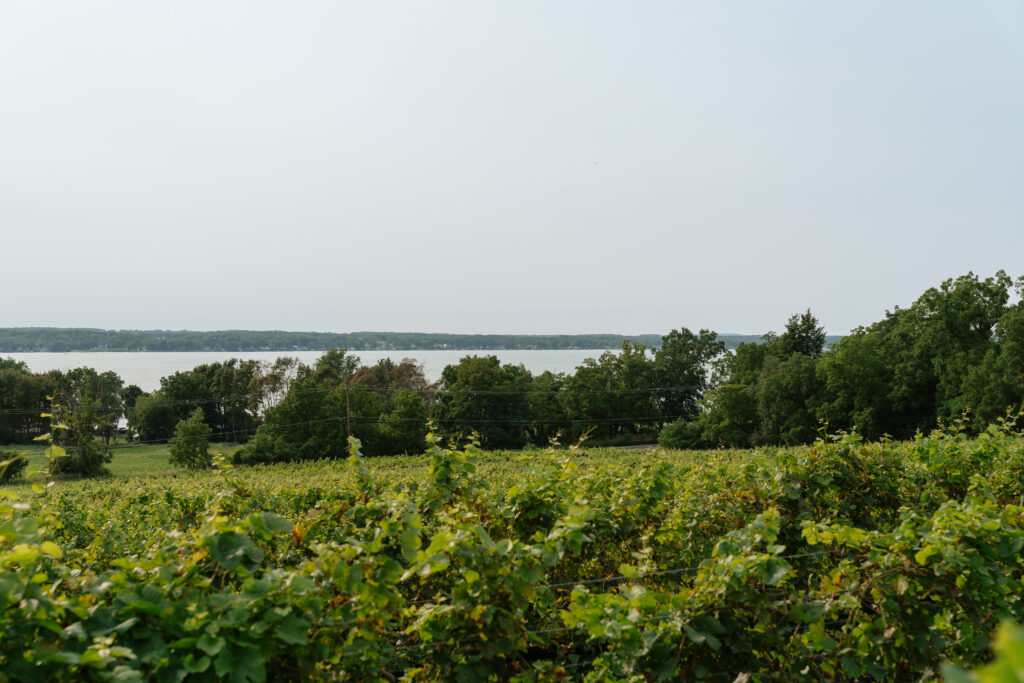
Grapes are some of the most inspiring plants on Earth. They naturally have chemical compounds that help defend them against diseases and predators, while also offering us that array of complex flavors, colors, and aromas that make us reach for another sip of wine.
Finding the balance between disease resistance and compelling flavor is a perpetual quest for growers in New York, many of whom have been working hard to become certified with the New York Sustainable Winegrowing seal.
As the number of disease-resistant cultivars suitable for New York growing rises, so does the interest in them from growers. But pulling out one set of vines and replacing them with another is not only cost-prohibitive, but it also means growers will need to wait several years for the first suitable harvest—an incredible financial hardship.
Plus, few growers want to plant a grape without knowing what they can expect in terms of disease resistance. (And…they want the resulting wine to taste good!) Quite the conundrum.
Which is where the New York Wine & Grape Foundation (NYWGF) comes in. NYWGF works every year with Cornell AgriTech in Geneva and Cornell Lake Erie Research and Extension Lab in Portland on dozens of individual research projects.
Every year, NYWGF’s Research Committee funds a select number of particularly promising projects based on current industry needs. The Foundation recently released a raft of reports summarizing findings by scientists, and one included research from experts studying how disease-resistant cultivars perform in the field and glass.
This year, Hans Walter-Peterson, senior extension associate for the Finger Lakes Grape Program at Cornell Cooperative Extension, and Alice Wise, senior issue educator and viticulturalist at Cornell Cooperative Extension in Suffolk, issued important new reports with promising findings for growers and wine lovers alike.
Hybrids Are a Big Part of the Future
No one has a crystal ball, but most scientists are forecasting an ever-increasing role for hybrid grapes in our future as more extreme weather patterns become the norm.
“Hybrids will play a larger role in viticulture in the future, particularly since there are so many significant breeding programs around the world as well as here in New York,” Wise says. “This will be particularly true if disease resistance is enhanced in the newer selections.”
Still, she notes that hybrids “vary in their performance and degree of disease resistance, with differences in viticultural performance as well.”
She notes that there are several standout grapes that manage to fight disease while tasting fantastic.
“I like the two Sauvignon Blanc hybrids and the Cab Sauv hybrid,” Wise says. “Growers like the wine from Aravelle, which is a Cayuga White and Riesling cross from Cornell. However, it has some challenges in the vineyard.”
Walter-Peterson shares growers’ enthusiasm for Aravelle, seeing it as a tasty grape that manages to face down some of the worst vineyard diseases.
“Aravelle’s fruit does not develop bunch rot nearly as easily as one of its parents, Riesling,” he says, adding that when compared with Riesling during a sensory analysis, it rated “the same” as Riesling in terms of fruitiness, aromatic intensity, and perceived sweetness when picked later in the season with higher sugar levels.
But Hybrids Are Not a Panacea
Still, hybrids can’t solve all of the world’s problems—and a hybrid that performs well in Long Island won’t necessarily translate that stellar performance to the Finger Lakes.
Wise thinks that utilizing hybrids, while also exploring the place for biological pesticides, will lead to better outcomes.
Hybrids are still susceptible to black rot and phomopsis cane and leaf spot, for example.
“Biological pesticides will likely have a role in the future, but there needs to be more local work done to understand how best to use them,” she says, adding that viticulturalists will also have to “immerse themselves in technology, with AI, digital ag, drones, robots. That is where all of agriculture is headed.”
Walter-Peterson concurs with Wise on the need for openness to and a more thorough understanding of spraying regimen possibilities.
“We never say that any variety will completely eliminate the need for pesticides because the pressure is so great here,” he says. “Depending on the type of genetics that confer resistance, it is possible that pathogens could evolve to overcome that resistance.”
Also, he notes that the success of a variety often depends on where it’s grown.
“Marquette and Itasca are both from the breeding program at the University of Minnesota, where cold tolerance is a major priority for the grapes they develop,” Walter-Peterson points out. “Here in New York, while these grapes are still pretty cold hardy, they have other issues that are giving growers some pause about adopting them on a larger scale.”
For example, both grapes emerge from dormancy earlier than most cultivars the team has worked with, Walter-Peterson says, making them susceptible to frost damage. Considering the rough Spring New York just experienced, this issue should be top of mind for growers.
The Future Is in Vintners’ and Wine Lovers’ Hands
While researchers can shape planting decisions, ultimately, the way those grapes are grown and then turned into wine is out of their control. And no one has any control over what people actually drink.
Wise is hoping that winemakers begin to work with hybrids for some of their premium selections.
“Currently, winemakers on Long Island take our fruit and make carboy wines,” Wise says. “Those are interesting and worthwhile, but they do not and cannot fully explore wine quality potential.”
For his part, Walter-Peterson is hoping that more people understand how inherently eco-friendly hybrids often are.
“Hybrids are all more disease resistant (at least to certain diseases) than vinifera, which means fewer pesticide sprays are needed,” he says. “Consumers who want to support sustainability in farming should ask about where disease-resistant grapevines play a role in a winery’s product line and purchase wines made from these when they can.”