

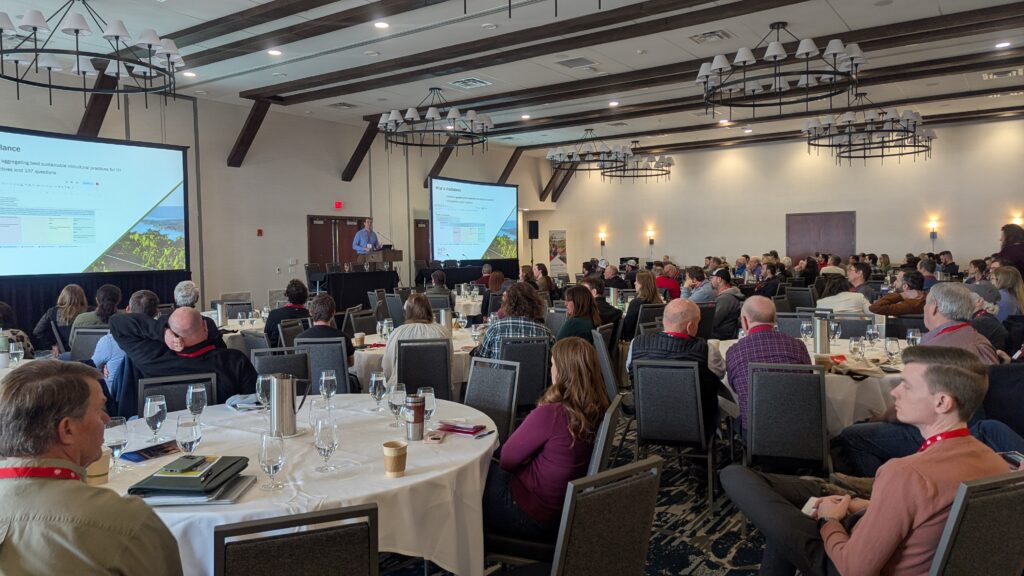
Earlier this year, grape growers, winemakers, students, researchers, and business leaders from New York and surrounding states attended B.E.V. NY. This year, the conference was held March 4-5 in Canandaigua, NY, in the Finger Lakes, where the wine industry gathered at Hotel Canandaigua for the most significant New York grape and wine industry educational event.
Founded in 2014 by Anna Katharine Mansfield, Hans Walter-Peterson, and Chris Gerling from the Cornell Cooperative Extension Program, the conference focuses on business (B), enology (E), and viticulture (V). The trio continues to organize the conference annually, and now that the event has passed and they’ve had a chance to breathe, we spoke with them about the 2025 B.E.V. NY.
The Origins of B.E.V. NY
The conference was born out of a need for an easier way for everyone in the industry to communicate and collaborate.
“The Enology Extension Program and the Finger Lakes Grape Program each had their own meetings for many years before then, but there was very little opportunity for growers to hear what winemakers were learning about, or vice versa,” says Walter-Peterson.
Realizing there was a lot of overlap between the two meetings, a plan to unite them began to form.
“Chris and Hans started discussing the importance of cross-over extension events, where grape growers could learn about winemaking and winemakers could learn about grape growing,” says Mansfield. So, she and her two Extension colleagues combined their efforts. “This gave attendees the chance to learn about both areas without having to find the time and money for two different events.”
The core mission of the new combined event was to provide the New York wine industry with the best research-based information to date.
“We have never wanted to have any agenda or motive beyond knowledge transfer. Over the years, we have spent a lot of time on formats and the best ways to organize sessions and days, but always with that core mission in place,” says Gerling.
The Value of Gathering Together
“We work very hard to deliver a timely and relevant program, but I think it’s also very important for producers to just get together and catch up,” says Gerling. “The stories and advice that are shared in the audience are just as useful as the presentation topic.”
The conference also gives attendees the chance to look at broader topics that aren’t discussed at other events.
“The programs and meetings that the Finger Lakes Grape Program hosts during the rest of the year are usually very focused on ‘nuts and bolts’ subjects pertinent to that time of the season,” says Walter-Peterson. “Questions such as ‘Why is downy mildew showing up now?’ or ‘What should I use to control this weed that is getting out of control?’”
He believes B.E.V. NY is a chance to address broader issues. “While we do some of [the types of topics that would have been covered at Finger Lakes Grape Program] at B.E.V. NY, it’s also a chance to address broader issues like how the market is behaving and how it’s influencing NY wineries and vineyards. The organizers can also bring in speakers from outside the regular roster from Cornell with different perspectives about winemaking or grape growing.
Networking is also a big part of the event.
“Our industry is pretty collaborative, but they don’t always have chances to interact in large groups. We give them a chance to do that,” says Mansfield. Breaks and meals are built into the schedule so there is ample time for people to connect.
“From an Extension point of view, gathering together also gives us a chance to take the temperature of the industry—what people are worried about and what’s trending, those kinds of things,” she says.
Between the sessions and the networking, things happen that make an impact.
Gerling recalls that through a previous conference, knowledge was shared that led to a reduction of the amount of green pepper aroma in New York Cabernet Franc and Cabernet Sauvignon. Research shared at B.E.V. NY about the compounds that create the aroma and what can be done in the vineyard to mitigate it. That led those attending the conference to take it back to the vineyards.
Attendees also become familiar with the resources Cornell offers and leave with the understanding that they can reach out with specific questions at any time.
“That’s important because with multiple wine regions, more than 400 wineries, and a wide variety of needs, it’s hard for the Extension to anticipate every issue that might arise,” says Mansfield. If a winemaker recalls an Extension employee talking about something they later have a question about, they know where to go to get the information.
2025’s B.E.V. NY Conference
About 225 people attended the conference on Tuesday, and about 200 attended on Wednesday. Platinum sponsor E&J Gallo welcomed attendees on Tuesday before keynote speakers spoke about the “Economics of Grape Production in New York” and “When is it Time to Remove a Vineyard?”
Attendees had the opportunity to sit in on several breakout sessions on a variety of topics and also visit the trade show exhibitors. The general format, according to Mansfield, is lots of one-off sessions for items of immediate importance.
“We focused on low- and no-alcoholic products because that area has seen significant growth recently, and we have local producers who are quite successful at reaching those consumers,” says Mansfield, in reference to one of the breakout sessions
There were also sessions related to two sensory experiences, a producer’s panel, a technology talk, microbial spoilage, vineyard management, and more.
“The conference tries to be relevant to the issues that the industry is looking for help with each year,” says Walter-Peterson. “One of the biggest things facing the industry right now—globally, not just in New York—is the slowdown in wine sales and what’s behind it.”
That important issue which is top of mind of everyone in the industry was the reason behind several of the panels and sessions including the The State of the Wine & Grape Market —National & NY Perspectives panel on the second morning, the low- and no-alcohol session, and a session on the current cost of growing grapes.
“Other topics were a result of current research being done, such as risk of off flavors from volatile compounds or insects, or just things we’re interested in based on new approaches to old problems, such as mousiness,” says Gerling.
Walter-Peterson adds, “I’ve been told that people were happy overall with the program and the venue.”
The organizers also recognize the invaluable contribution of sponsors, whose support allowed for a high-quality experience.
Now, their task is to go through the evaluations from the attendees and vendors for feedback before starting to plan all over again for B.E.V. 2026.