
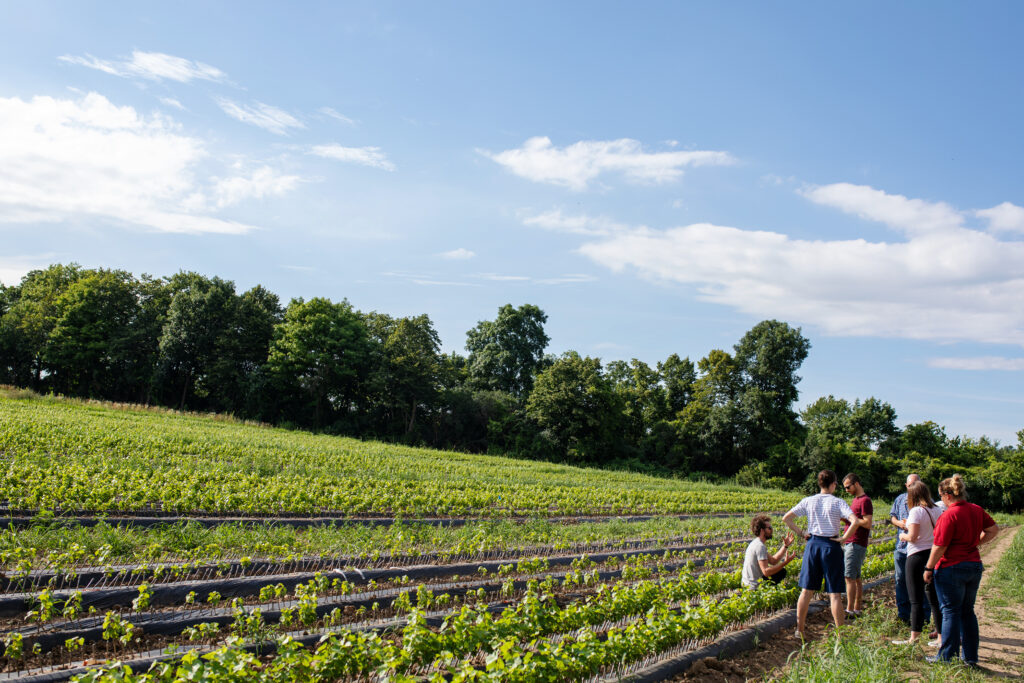
At its root, sustainability is about life. Official definitions of sustainability, such as this one from the U.S. EPA, include the basic idea that we need a healthy natural environment to not just survive, but thrive.
There’s more to it, of course.
A product that is cultivated in the most environmentally responsible way instantly becomes unsustainable the moment it fails to offer the person or organization that made it the means to stay in business. And if the production or consumption of a so-called sustainable product doesn’t also support the community of people who helped make it, long-term viability becomes impossible to achieve.
When it comes to wine, it should be noted that there is no widely accepted, official definition of “sustainable wine” or even “sustainable wine businesses”.
But in New York, many of the state’s 400+ wineries are embracing environmental and social sustainability in ways that make sense for their businesses, and the people who work in and around them. Many opt to pursue third-party verified certifications and formal regionally-focused sustainability initiatives for the work they do in their vines and cellars. (Third-party certification ensures that products bearing official labels like “USDA Organic” follow strict growing and production guidelines that are reviewed and confirmed by a neutral review committee.)
And many of New York’s winemakers go beyond the demands of these certifications, instituting energy conservation programs and social initiatives that they believe serve the needs of their community best.
“For us, sustainability isn’t a single initiative or certification, but a guiding principle that informs how we farm, how we do business, and how we engage with our community,” Alex Kates, director of retail operations, marketing, and sales at Hermann J. Wiemer Vineyard and Standing Stone Vineyards, says. “Environmentally, it means caring for the land in a way that ensures its health for generations to come.”
Socially, Kates says, the teams at both Finger Lakes wineries aim to create “a workplace where our team can grow, thrive, and build meaningful careers, while contributing positively to the wider Finger Lakes community.”
Economically, the goal is to “reinvest in our region, support local businesses, and ensure that the resources generated through our work continue to strengthen the community around us.”
To many people across markets and consumer segments, sustainability is an increasingly important consideration when they’re deciding what to purchase. A report from global management consulting firm Bain & Company shows that 64% of consumers report “high levels of concern about sustainability.”
Read on for insight into how New York winemakers are addressing these concerns head-on.
Sustainability in the Vineyard
Sustainability, like great wine, starts in the vineyard.
At Hermann J. Wiemer, the vineyard crew has eschewed herbicides for more than 20 years, and today, the 33-acre vineyard is focused on regenerative farming.
“Instead of relying on synthetic fertilizers and chemicals, we aim to generate our own natural compost and nutrients, where cover crops and livestock are a key component, reducing (or eliminating) the need for external inputs,” Kates explains.
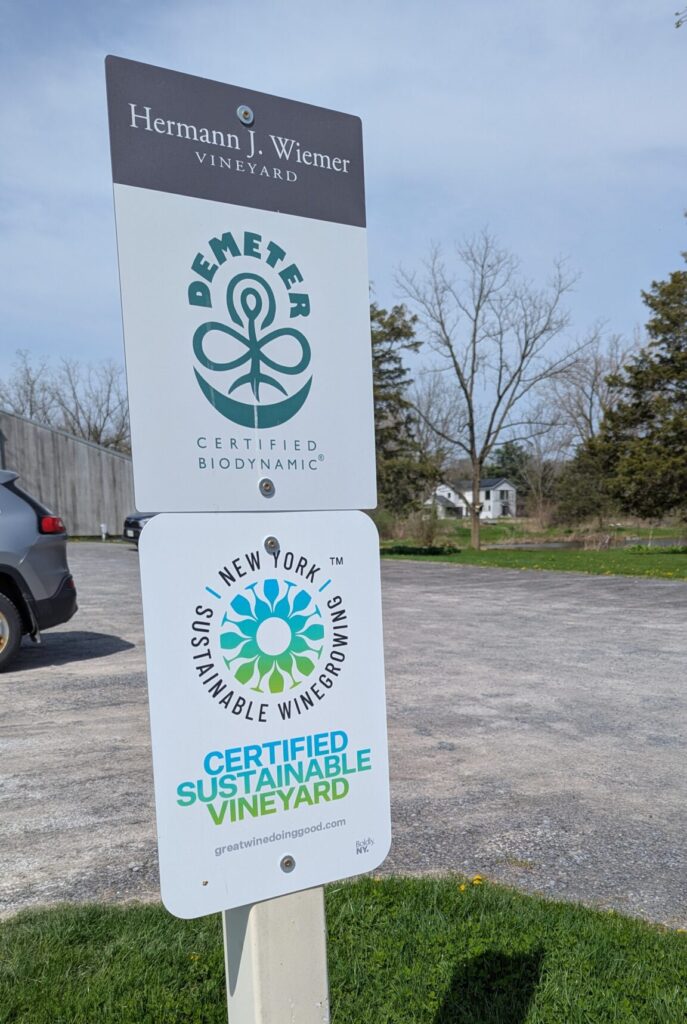
In 2023, the winery became Demeter Certified Biodynamic, a certification that ensures no chemicals were used to grow the wines, and that also ensures farmers actively nourish the soil and protect the environment.
And like many other winemakers in the Empire State, Hermann J. Wiemer also joined the New York Sustainable Winegrowing program when it debuted in 2023. The program certifies vineyards through third-party audits that ensure wineries are reducing chemical inputs, boosting soil health, protecting the water, working toward social equity, and more.
Sparkling Pointe Vineyards & Winery in Long Island has also long been committed to going green in the vineyard, joining the Long Island Sustainable Winegrowers Organization (LISW) in 2014.
“The LISW utilizes international standards of practices in quality wine-grape production refined for the northeast,” explains Melissa Rockwell, director of operations at Sparkling Pointe. “As members of the LISW, Sparkling Pointe’s vineyard applications are designed to balance viability within the conditions of the Long Island region with input reduction, soil health, water protection, and preservation of biological diversity.”
Most recently, Sparkling Pointe joined the New York Sustainable Winegrowing program, and starting with 2023’s vintage, all wines will be vegan, meaning no animal by-products are used as fining agents.
Sustainability in the Cellar and Tasting Room
Billsboro Winery in Geneva doesn’t own vineyards, but they do source their entire 4,500-case production from winegrowers certified by the New York Sustainable Winegrowing program, including Sawmill Creek Vineyards, Bright Leaf Vineyards, and Lake Road Vineyards.
Billsboro is also 100% solar-powered, 100% heat pump cooled and heated, and plastic-free, says winemaker and co-owner Vinny Aliperti.
“We compost food waste and event materials, and we founded the FLX Craft Beverage Coalition, which has spearheaded programs through Wegmans and Casella Waste to recycle shrinkwrap and divert wine bottles from the landfill,” Aliperti says.
At Fox Run Vineyards in the Finger Lakes, proprietor Scott Osborn says that in addition to joining the New York Sustainable Winegrowing program, Fox Run has been a certified Lake Friendly Farmer since 2002.
But the winery goes well beyond what those certifications require.
“We are almost entirely solar powered,” Osborn says. “And we have a 4.5-acre Monarch Butterfly and Bee Habitat on our estate. We crush used bottles into sand and then put the sand in our vineyard. And every few weeks, we take used shrink-wrap to Wegmans where they recycle it for synthetic building materials.”
Rockwell says that Sparkling Pointe now recycles all of its glass wine bottles, cardboard, and paper—and she has prioritized sustainable energy.
“We use a Net-Zero energy consumption system in our storage warehouse,” Rockwell says. “It has geothermal wells and solar photovoltaic array roofing—we were designated as the first Greenlogic certified Zero Energy Warehouse in the state.”
Sustainable Roots in the Community
None of New York’s wineries would be truly successful without the support of the community they’re in. Many find numerous ways to repay that support.
“Sparkling Pointe supports organizations which provide employment, training, education, and assistance to people with physical and developmental disabilities,” Rockwell says, noting that the businesses and nonprofits they support include Eastern Long Island Hospital, New York Law School, The Kosciuszko Foundation, Cornell Cooperative Extension, Long Island Sustainable Winegrowing, CAST, and The Nassau Art Museum.
“We also offer a wine subscription program called Bubbly Box,” Rockwell says. “Our Bubbly Box membership is a subscription service that sends 2 bottles, six times per year, for a flat rate of $80 + tax. We donate $5.00 per every box sold to a featured charitable cause in support of Agriculture, Aquaculture, and Sustainable Living.”
This year’s partner is Group for the East End. Since 1972, Group for the East End has led the way in protecting and restoring the environment of eastern Long Island through education, conservation, and advocacy.
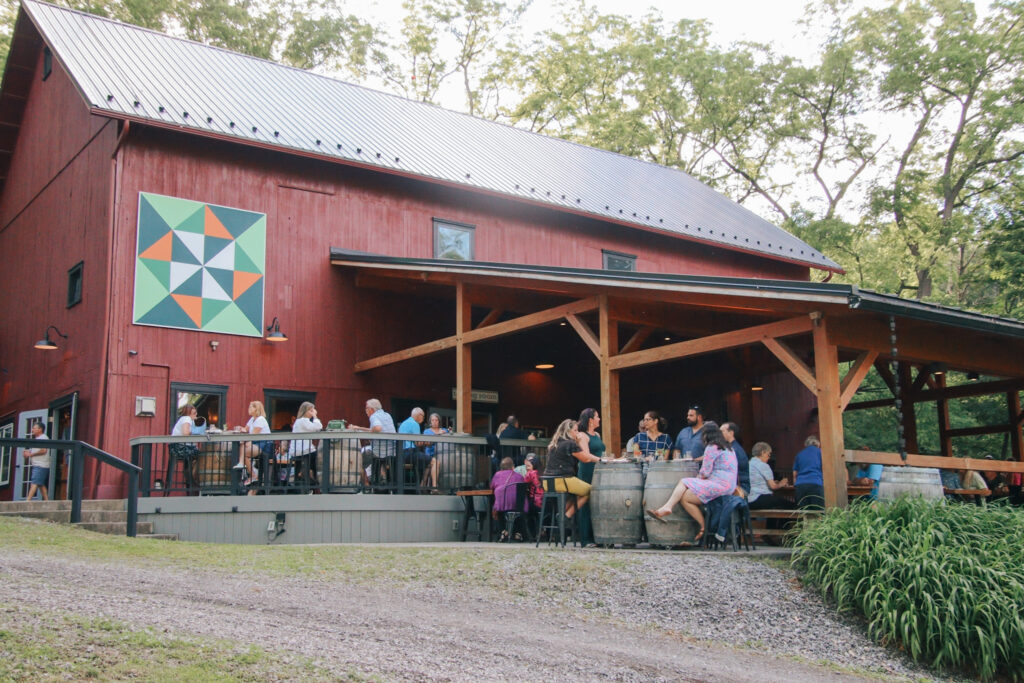
At Billsboro, Aliperti and the vineyard crew share their green thumb.
“We host sustainable gardening classes run by staff member Michael Warren Thomas,” he says. “And we also support local arts and environmental organizations. Kim [Aliperti’s wife and the co-owner of Billsboro] has been on numerous boards, including the Boys and Girls Club, Geneva Community Projects, Finger Lakes Wine Alliance, and is currently a member of the Geneva Town Board.”
Sustainability will mean something slightly different to everyone, and it may be impractical to ever try to find a one-size-fits-all approach to it. But the true spirit of sustainability is easy to spot.
“Sustainability isn’t just a moral imperative, it is a smart, future-proof strategy,” says Osborn. “Our success shouldn’t come at the cost of environmental destruction, social inequality, or economic instability. When we prioritize sustainability in the workplace, we are creating an inclusive environment for our employees to participate in long-term thinking about the future and what might happen. This is important because we need to be aware of our present environment and be ready to deal with the challenges of an ever-changing world that can include challenges to our industry, to our employees, to our region, and to our community.”