
In the ever-evolving world of wine and grape production, research plays a crucial role in advancing knowledge, improving practices, and ensuring the sustainability of the industry. NYWGF’s commitment to research is evident in its annual research budget, which typically ranges between $350,000 and $500,000. The NYWGF Board of Directors is proud to share the results of 2025-26 funded research projects through individual reports, articles, and a series of upcoming webinars. Featured in this article are two NYWGF-funded studies:
Preparing the New York Grape Industry for a Future Without Broad-Spectrum Fungicides | Principal Investigator: Kaitlin Gold, Assistant Professor of Grape Pathology at Cornell AgriTech
Efficacy of strobilurin fungicides as alternatives to Ziram and Mancozeb for control of Phomopsis cane and leaf spot in the Lake Erie Region | Co-Principal Investigator: Dr. Michael Campbell, past Director of the Penn State Lake Erie Regional Grape Research and Extension Center
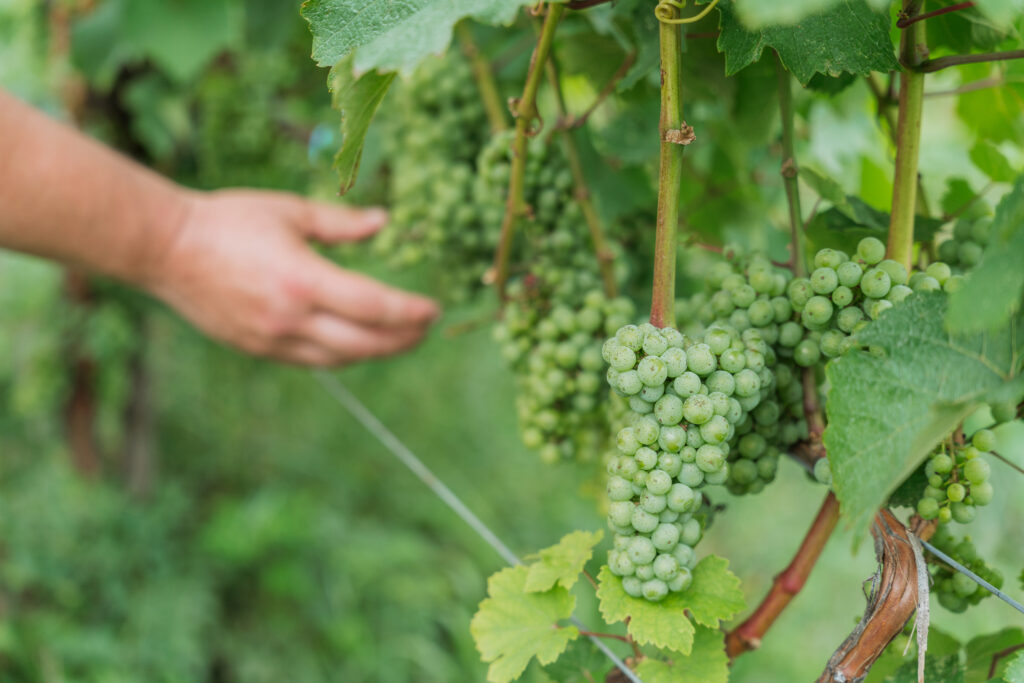
New York winemakers are literally and metaphorically rooted in their communities.
Increasingly, they are looking for new ways to be even better neighbors and stewards to the land.
There has been a growing movement to become certified with the New York Sustainable Winegrowing seal, thanks to the introduction of the program and Trustmark seal. And as key fungicides face increasing regulatory scrutiny, vintners and growers are hoping to find ways to halt or significantly reduce their reliance on these sprays—without imperiling their harvests.
But the climate pressures that warranted broad-spectrum fungicides in the first place still exist. And growers don’t have time to experiment with untried methods that may or may not be effective. This puts them in a bind.
Which is where the New York Wine & Grape Foundation (NYWGF) comes in.
Every year, the NYWGF’s Research Committee funds a select number of particularly promising projects based on current industry needs. The NYWGF recently released a raft of reports summarizing findings by scientists, and two of those included research from experts studying how best to combat fungus without broad-spectrum fungicides.
Kaitlin Gold, assistant professor of grape pathology at Cornell AgriTech, and Dr. Michael Campbell, past Director of the Penn State Lake Erie Regional Grape Research and Extension Center, share insights into their research and discuss what’s next.
Concern Over Loss of Essential Tools
For many viticulturists, conventional fungicides have become the gold standard for fighting downy and powdery mildew.
“We designed our research with the goal of helping New York grape growers prepare for the expected loss of broad-spectrum fungicides,” Gold says. “We tested how biological and conventional fungicides perform in rotation and tank mixes. We wanted to emerge with clear advice on what kinds of spray programs can replace broad-spectrum spray programs.”
The biggest challenge, Gold explains, is the climate.
“It is just so conducive to disease development,” she explains. “But cost is also an issue. There are major cost differences between conventional and biological sprays, with biological sprays often being far more expensive.”
Campbell agrees that concerns over the EPA’s proposals to phase out conventional fungicides like ziram and mancozeb, used to control Phomopsis in both juice and wine grapes, would “reduce the tools grape growers have to control this fungal pathogen, which causes cane and leaf spot.”
The fungal disease, known formally as Phomopsis, damages leaves and vines, reduces vigor, and diminishes crop yield.
“The goal of our research was to evaluate strobilurin fungicides as a control of Phomopsis cane and leaf spot disease in Niagara and Chancellor grapes,” he says, noting that in the Lake Erie Grape Belt, Niagara is largely processed as a juice grape, while Chancellor is processed as a wine grape.

Excitement Over New Formulations in Biological Fungicides
The research projects, Gold and Campbell agree, show auspicious outcomes.
“Our results support the use of strobilurins as an alternative to ziram and mancozeb,” he says.
Gold focused on field trials with Chancellor and Traminette.
“We evaluated how biofungicide timing and the rotation between biofungicides and conventional sprays affected disease control,” Gold says. “We studied Ranman, Zampro, Mirages Prime, and Gatten, applied alone or mixed with biological products that span different modes of action, like Lifegard, Howler Evo, and Warhammer.”
The biggest takeaway for Gold, she says, is that biologicals have come a long way since she first deployed them in field trials.
“Howler Evo in particular is so much better,” she says. “And using them with Lifegard and other biologicals creates incredible synergy. But it’s not cheap. Some of these sprays are $70 an acre.”
At the end of the trial, Gold says she is confident that growers can swap out up to 50% of their conventional sprays with biologicals and get the same result.
“We are not getting new conventional fungicides, so as an industry, we have to begin to shift our approach,” she says. “There are different layers with biologicals. Some are protectants; others combat diseases. It’s like a logic puzzle figuring out which ones to use when.”
Supporting Growers in the Future
Both Campbell and Gold are feeling good about a greener future.
Campbell says that the Penn State Lake Erie Regional Grape and Research Center will hire a new director, who will continue the research into fungal pathogen control.
Gold, whose most recent research aggregated data from 50+ programs across the past five seasons, plans to continue multi-year replication in both the Chancellor tank-mix and Traminette, expand the evaluations of sprays, and pilot a curriculum to create specific, actionable advice for growers.
There is no silver-bullet spray that will eliminate the challenges posed by the climate. But as the tools growers are permitted to use evolve, and as scientific advances transform the efficacy of the first generation of biological fungicides, the range of options increases, making it easier for growers to be both economically and environmentally sustainable.

About our Research Program
Since its creation in 1985, NYWGF has sponsored an ambitious and comprehensive program in close coordination with the industry and academia. As with the promotion program, private sector funding is required to leverage the state matching funds. NYWGF’s annual research budget is normally between $350,000-$500,000 to support dozens of individual projects, mostly conducted by Cornell University’s New York State Agricultural Experiment Station in Geneva.