
Fueled by a consumer desire for food-friendly, versatile, and easy-drinking red wines, lighter-style reds are increasingly popular both in the U.S. and in global wine markets. That’s good news for New York winemakers and for those of us who drink wines from the Empire State. With its cooler climate, New York is well-situated for producing what wine drinkers are clamoring for.
Why do cooler climate wine regions, in general, produce lighter red wines?
Grapes don’t ripen as quickly in cooler climates as they do in warmer climates such as California’s Napa Valley, Australia’s Barossa Valley, or most of Southern Italy’s winemaking regions. Less ripeness typically means lower sugars and higher acidity in the grapes. In red wines, that often translates to lighter styles where alcohol is slightly lower, and acidity is slightly higher. This adds freshness, tart red fruit flavors, and earthiness to the wines. These wines can be more versatile when it comes to food pairings, but they are usually good solo sippers, too.
We spoke to producers whose portfolio includes lighter-style red wines to get their insights.
Consumers are Discovering New-to-Them Wines
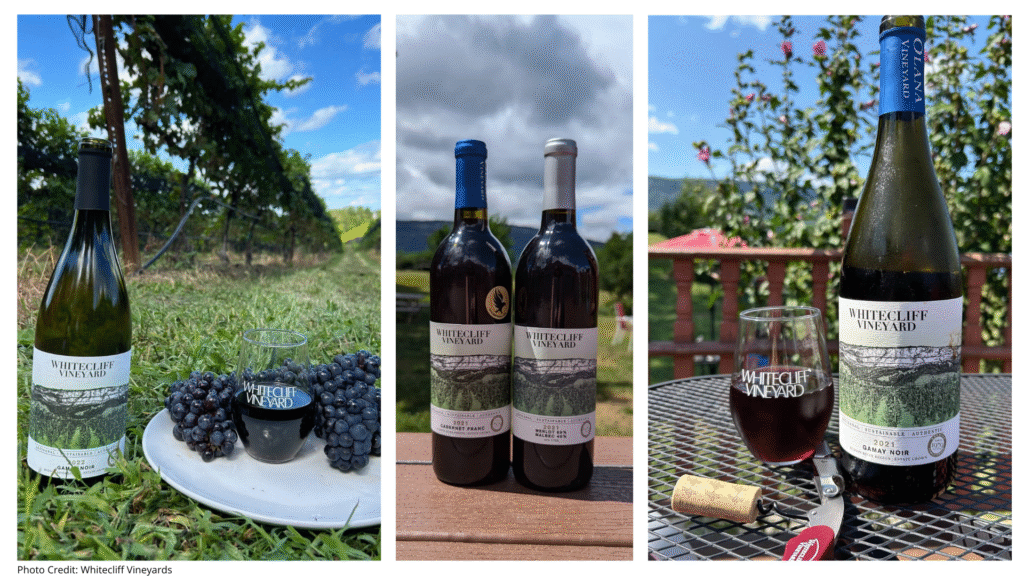
“I find that drinkers are most commonly looking for full body reds, but there is definitely a new receptiveness to lighter reds, particularly in the context of being chillable in warmer weather,” says Yancey Stanforth-Migliore, co-owner of Whitecliff Vineyard & Winery in Hudson Valley.
The Hudson Valley, says Stanforth-Migliore, is a cool-climate growing region where the grapes have lower sugars at harvest, creating wines with lighter alcohol, resulting in a lighter-bodied wine. But that cool climate doesn’t mean that some red grapes can’t fully ripen.
“While the most full-bodied wines, like Cabernet Sauvignon, tend to need a longer growing season than we have here, we can confidently ripen varietals like Gamay Noir, Pinot Noir, and Cabernet Franc,” she says.
Gamay Noir, sometimes simply called Gamay, was one of Whitecliff’s first grapes planted in an experimental plot in the 1980s.
“We found it to be one of the most cold-hardy of the red vinifera grapes and well-adapted to our climate,” says Stanforth-Migliore. The grape’s quality is not a problem, particularly in warmer years when it ripens well. Whitecliff’s Gamay Noir is award-winning and recently received a 92 from Wine Enthusiast. Despite its quality, it’s not the most well-known grape.
“We often have to introduce Gamay Noir to people as the ‘Beaujolais Grape,’ since many don’t realize they have tasted it before,” Stanforth-Migliore says. “Since we have offered it for most of our 26 years in business, it has a significant following among our customers. People recognize that its light body makes it flexible with food. For example, it’s a perfect wine if you want red with your roast chicken or turkey.”
While the wine already has a good following, the trendiness of lighter styles is introducing Whitecliff’s Gamay Noir to those who like to try what “feels new,” as Stanforth-Migliore says, and the recent trend of drinking lighter style reds has also invited some drinkers to discover that some red wines are enjoyable with a bit of a chill on them.
“In this case, the idea of serving a red with a little chill opened up the world of red for people in hot weather, when they otherwise wouldn’t have touched it,” she says.
The Secret is Out that New York can Produce Great Lighter Reds
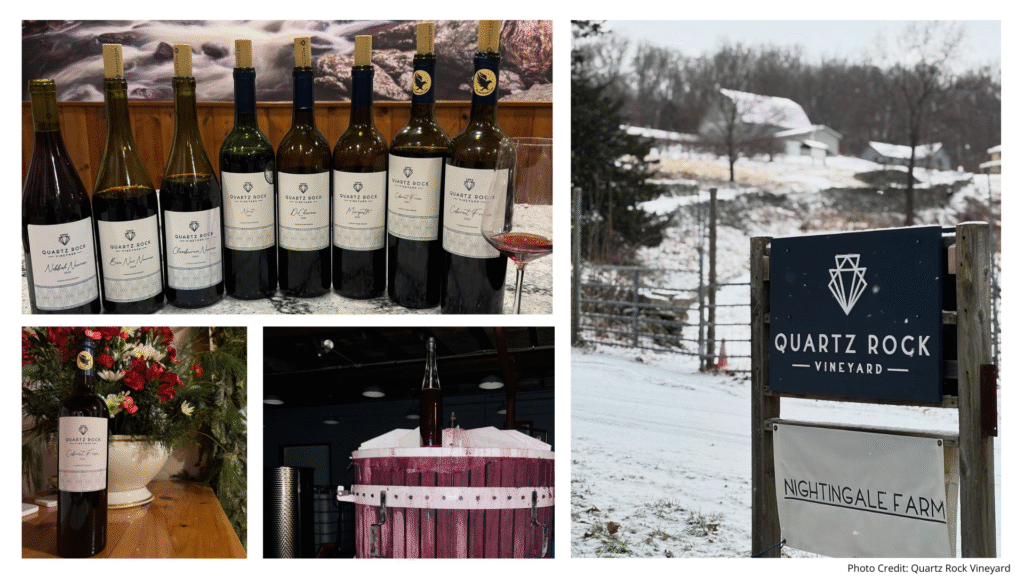
At Quartz Rock Vineyard in the Hudson Valley, customers are coming in looking for lighter reds.
“We aren’t so sure this is a shift rather than a recognition that the Hudson Valley can grow excellent grapes that make excellent lighter red wines, such as Cabernet Franc. Basically, the secret is out,” says Dan Heavens, co-owner of Quartz Rock.
Heavens feels the region is great for producing quality lighter red wines for several reasons.
“First, there is a moderating effect from the Hudson River where it releases heat at night and absorbs during the day,” he says. “Second, the Hudson Valley climate is great for grapes with longer hang times, lower sugar accumulation, and slightly higher natural acidity. Lastly, the Hudson River Region is one of the oldest wine-growing regions in the US with similarities to the Loire [in France] that encourage elegant, aromatic, terroir-driven reds.”
One of Quartz’s popular lighter-style reds is a grape more often found in northwest Italy than in France, though, Nebbiolo. It’s a newer grape for the winery.
“We started small in 2021 to see how it would go, and we’ve incrementally added more over the past three years,” says Heavens. “It’s still a small block with the potential to plant more.”
“There is a lot of excitement about the Nebbiolo from our customers, and they are looking for more,” he says.
The past two years have seen favorable growing seasons for the grape.
“We will need to see how the next few growing seasons go. We’ve been blessed with a dry harvest season the past two years, which is great for Nebbiolo—and all grapes. We could use more of those going forward,” he says.
Fortuitously, the Nebbiolo was planted before the lighter red trend became popular, but Heavens is still glad to see the movement toward the style.
“It’s great that lighter reds are getting more appreciation. They usually offer fresher, more nuanced flavors with lower alcohol,” he says. “There are usually more versatility and food pairing options, also, making lighter reds an excellent decision when pairing.”

In the Finger Lakes, Lighter Reds are Often the Norm
At Weis Vineyards on Keuka Lake in the Finger Lakes, there doesn’t seem to be a shift toward people specifically asking for lighter reds.
Perhaps that’s because, in part, the climate of the region lends itself to lighter reds, so the customers don’t need to ask for them.
“The Finger Lakes is naturally a cool-climate region, so our red wines tend to be lean, fresh, and bright,” says Ashlee Weis, co-owner of the winery. “Even though we’re not seeing a major push toward lighter reds specifically, cool-climate varieties give us a lot of room to play with styles that are bright, expressive, and food-friendly. Zweigelt fits right into that space.”
The lighter-bodied Zweigelt, most commonly planted in Austria, catches people’s attention, “especially European travelers who don’t expect to see Zweigelt in the Finger Lakes,” she says. Our first Zweigelt release was in 2018. We don’t have our own plantings at the moment, but we work closely with local growers who produce really beautiful fruit.”
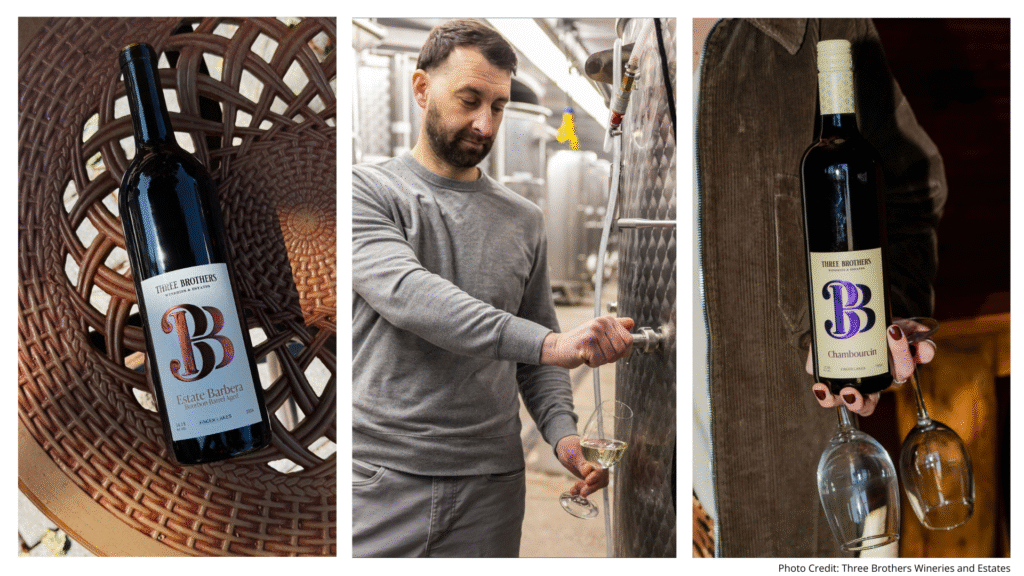
Also in the Finger Lakes on Seneca Lake, Three Brothers Wineries and Estates makes “traditional style red wines that reflect the region and the estate,” and according to Aaron Roisen, head winemaker, the “climate and the growing conditions elevate a lighter style.”
He also has faith in the local wine drinkers of the Finger Lakes, who are immersed in the region’s wine culture, believing they have a deep understanding of what the region can do and they’re able to “discern quality and creativity.”
And, since the Finger Lakes naturally lends itself to producing lighter-style reds, the quality wines of the region tend to be “aromatic-leaning to fully encompass the fruit profile and, as a result, are fruit-forward and more approachable.”
One of those fruit-forward, approachable wines is Three Brothers Barbera, a grape planted in its vineyards in 2006. Like Nebbiolo, the grape is most often found in Northwest Italy, and it’s also finding success in the cool climate of the Finger Lakes.
“The public finds it to be a curious and engaging wine. It grows well here and has many similarities to European parallels. The styles of wine that we make are happily appreciated and purchased with a lot of joy,” says Roisen.
Whether guests are walking into tasting rooms requesting lighter-style reds, or they already appreciate and love the style, whether it’s trending or not, it does seem New York wine drinkers are purchasing these approachable, food-friendly, easier-drinking wines “with a lot of joy.” And that joy is not poised to go away. “Chillable reds” are predicted to be hot this year, and many of the qualities of fresh, fruity, earthy reds are enhanced with a slight chill on them.