Wine publications frequently herald “emerging wine regions,” and New York is often cited as one of them, perhaps giving an impression that it’s only recently that the state has made strides in producing fine wine. But the truth is that New York has a deep history of grape growing, winemaking, and innovation.
Prohibition devastated much of the early success of winemaking in the state, but post-Prohibition, the Empire State reclaimed its place at the forefront of winemaking and innovation in the U.S. Thomas Pinney’s A History of Wine in America, Volume 2 explains that in the 1940s, New York made twice as much wine as any other state, except California. During that decade, the state was also a leader in the scientific and technical support of winegrowing at the Agricultural Experiment Station at Geneva (now part of Cornell University), again ranking only second in that discipline to California.
Today, New York is the second-largest wine-producing state in the nation, with close to 30,000 acres under vine, 11 AVAs, and more than 470 active wineries. Every one of them benefits from the wine industry’s past while also helping to create a bold future for New York wine. We spoke to a handful of winemakers and winery owners about changes they’ve experienced and where they see New York winemaking heading.
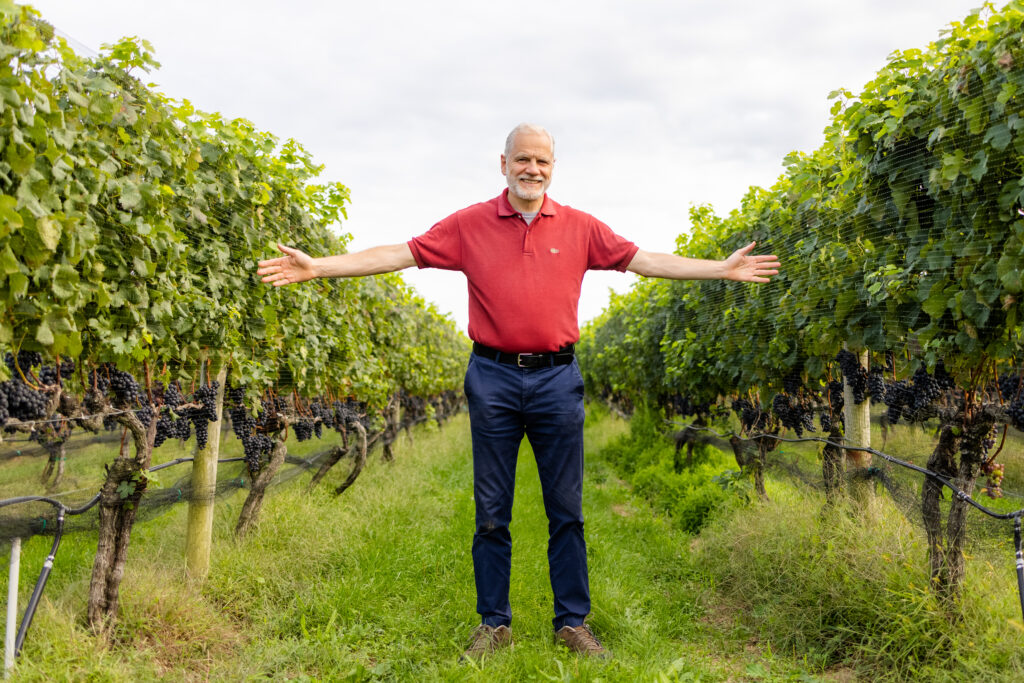
Roman Roth of Wölffer Estate Vineyard
Wölffer Estate Vineyard, founded in 1988 by Christian Wölffer on Long Island’s South Fork, started with just 15 acres of grapes—all Chardonnay—and now has more than 80 acres throughout Long Island, in addition to sourcing grapes from growers throughout the region. That growth is due, in part, to fully understanding the possibilities of what winemaking on Long Island can be. Roman Roth, winemaker and partner at Wölffer, shares two specific examples.
“In 2000, we created the first $100 Merlot on the East Coast from our oldest Merlot plantings from 1990,” says Roth. “We realized that our terroir has the potential to make, in combination with perfect detailed vineyard management, world-class wines.”
That revelation led Roth and his team to fine-tune and push the quality of Wölffer’s red wines so they have the concentration and depth that he believes can give them 40 to 50 years of longevity while being elegant and food-friendly long before that. Today, Wölffer’s reds are well received, including the current release of the 94-point (Wine Enthusiast), $125 Christian’s Cuvee Pinot Noir, which has sold out.
Another innovation didn’t come from a single ah-ha moment, but rather took two decades to come to fruition.
“I made the first dry rosé at Wölffer in 1992,” says Roth. That first rosé was the first step in what would eventually become Summer in a Bottle Long Island Rosé in 2013.
“This bottle created a firestorm and has become an iconic cult wine in the U.S.,” he says. “It’s a róse made on purpose, blending up to nine grape varieties to find the perfect window for each variety to pick vibrant and fresh grapes to make this most elegant rosé with playfulness and character.” Wölffer now produces 51,000 cases of that rosé.
As for the New York wine industry’s future, Roth sees it as bright, noting that New York wines can now be found in 37 states and 14 countries, and also points to the acceptance of local wine in New York.
“In the future,” he believes, “New York restaurants will proudly feature 10, 15, or 30 New York wines and have special local menu items.”
Roth also predicts more New York-centric tasting menus and winemaker dinners in New York City.
“We will build a New York food and wine identity that will bring tourists to the city in search of our food and our wines, and New Yorkers themselves will be proud of the quality of New York wines,” predicts Roth.
He sees this happening with not just the hard work of the wineries themselves, but also through collaborations like the Cab Franc Forward initiative and the support of the New York Wine & Grape Foundation.
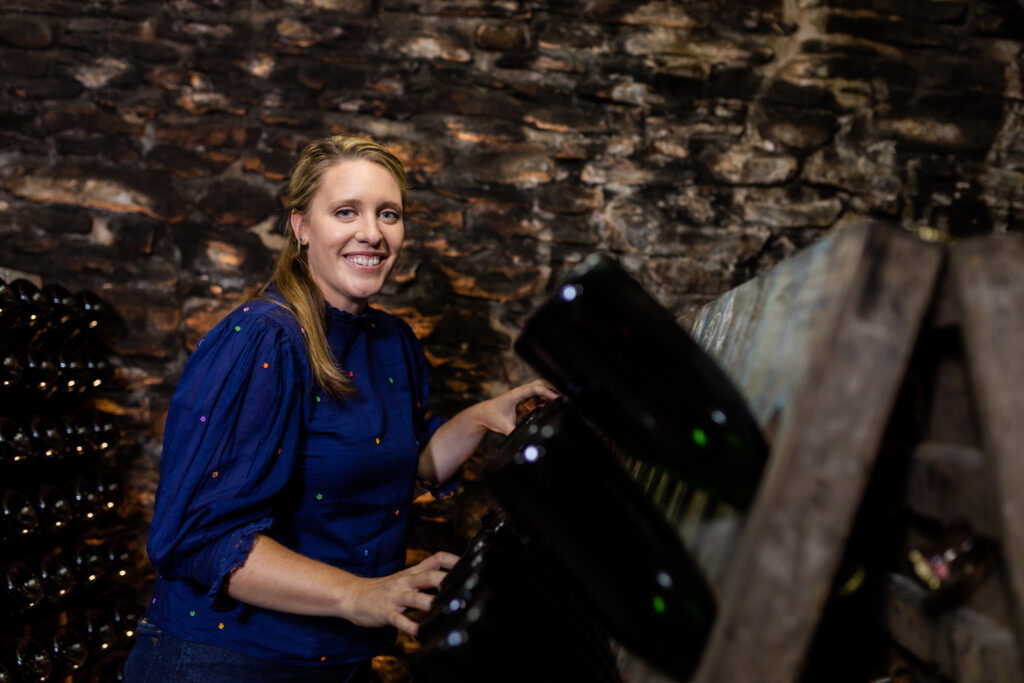
Meaghan Frank of Dr. Konstanin Frank Winery
A pioneer in the Finger Lakes, Dr. Konstantin Frank Winery is now family-owned and run by third and fourth-generation Fred and Meaghan Frank. If it were not for their father and grandfather, respectively, Dr. Konstantin Frank, New York wine might look very different today. Earning his Ph.D. in Viticulture from Odessa, Ukraine, in 1930, he was a leading expert in his field throughout Eastern Europe.
“He immigrated to New York in 1951 at the age of 52 years old, with empty pockets and no knowledge of English, in the hope of creating a brighter future for his family,” Frank says. “He fell in love with a special property in the Finger Lakes for its exceptional characteristics—poor soils and steep slopes. With decades of knowledge and experience, he planted his first vinifera vines in 1957 on the southwestern slopes of Keuka Lake with the hopes of growing world-class wines based on cool-climate grape varieties like Riesling, Pinot Noir, and Rkatsiteli.”
At the time, few thought Vitis vinifera could flourish in New York, but Dr. Frank defied the skeptics.
“At a time when most producers relied on native and hybrid grapes for sweet wines, he introduced the practice of grafting cold-hardy, phylloxera-resistant American rootstocks with cold-tolerant European varieties. His persistence and generosity in sharing cuttings and knowledge across the country sparked a renaissance in quality winemaking east of the Mississippi,” says Frank.
Dr. Frank’s son, Willy Frank, built upon that legacy.
“Willy pioneered méthode champenoise sparkling wines from Vitis vinifera varieties. His first vintage in 1985, labeled “Finger Lakes Champagne,” was a watershed moment for the region and helped position the Finger Lakes as one of the most exciting cool-climate sparkling wine regions in the United States. That spirit of innovation continues to define us today,” says Frank.
Although it’s no longer unique to the Finger Lakes, Frank recognizes that there are specific practices that must happen in the colder climate of the region and others in New York for Vinifera to survive.
“One of the most distinctive practices we use is hilling up, a technique Dr. Konstantin Frank introduced to the Finger Lakes when he arrived from Ukraine, where it was common in the cold winters of Odesa. Using a plow, we mound about a foot of soil around the base of each vine to protect the graft union, the most vulnerable part of the vine from winter damage,” she explains.
Many of the practices that Dr. Frank brought with him from Ukraine helped move New York wines forward, and his granddaughter sees that trajectory continuing throughout the state. Noting that New York, including many wineries in the Finger Lakes, is on the edge of something remarkable with sparkling wine.
“The national excitement around bubbles is undeniable, and the Finger Lakes offers it all from Pét Nats and carbonated styles to tank-fermented wines and, of course, the crème de la crème: méthode champenoise,” she says. “The next decade will be one of refinement and collaboration at a time when New York’s distinctive voice in the global wine conversation rings clearer than ever.”
As for one of the winery’s bottles that’s bridging the gap between the winery’s heritage and its future, Frank mentions the Margrit Dry Riesling sourced for the winery’s Seneca Lake Vineyard.
“This wine bridges our family’s deep heritage with a forward-looking spirit of innovation. Named for my grandmother Margrit Frank, whose grace, strength, and warmth helped shape our family’s legacy, it honors the women of the Frank family whose stories continue to inspire new generations,” she says.

Phil Plummer of Montezuma Winery
Located in Seneca Falls at the top of Cayuga Lake, the Martin family-owned Montezuma Winery opened in 2001 and has grown significantly. Some of that growth includes the family opening Idol Ridge Winery in Lodi, NY, in 2013, and this year, taking over Swedish Hill Winery & Vineyard on Cayuga Lake.
Phil Plummer, head winemaker for Martin Family Wineries, recalls that winemaking wasn’t the family’s first business.
“They took a weird path to winemaking,” he says. “They were commercial beekeepers who had a honey farm they turned into a meadery in Lake Ontario.”
“It was very experimental,” Plummer says, noting that along with honey wines, the family also made fruit wines. “Eventually they branched into grape wines, but they never left the other stuff behind,” and he half jokingly comments that “we’re going to try to ferment everything we can.”
At the wineries he oversees, trying out new techniques and strategies is common, and that harkens back to the heritage of the business.
“Coming to the industry from the perspective of starting with bees and honey instead of vines and grape wines, there is a lot more of this spirit of wanting to try new things, not taking the traditional path of learning the things we’re not supposed to do,” says Plummer.
That freedom to innovate rather than simply follow tradition is possible in New York because there is so much to work with.
“Riesling is grown in the same vineyard as Delaware, Baco Noir, and Cab Franc. It’s a weird mix of different grape varieties, but being able to live in all those [grape] worlds is really exciting,” he says. Comparing it to the options a painter has, he believes New York has “one of the most robust paint kits you can ever ask for.”
That allows for creative freedom, and, coupled with what Plummer says is an “incredible winemaking community that’s collaborative and willing to share and try new things,” is what moves New York forward.
That progress paradoxically involves looking back a bit. “We’re revisiting a lot of the stuff that made New York have a wine industry in the first place,” he says. “We’re working with a lot of the old school heirloom hybrid varieties and saying, ‘What can we do with these now?’”
After decades of varieties like Catawba, Delaware, Concord, and Diamond being pushed aside or simply sweetened to “keep the lights on,” Plummer is excited about how those grapes can be turned into wines, including sparkling ones, that are compelling for today’s wine drinkers.
One bottle that bridges that gap between heritage and innovation is the Montezuma Diamond Pét-Nat.
“Diamond is typically made still with sweetness,” he says, but by turning it into a sparkling Pet Nat, it takes on a lot of complexity.
“It’s a balanced nod to what happened in New York before. Heirloom, but in a style that’s been rediscovered,” Plummer says.
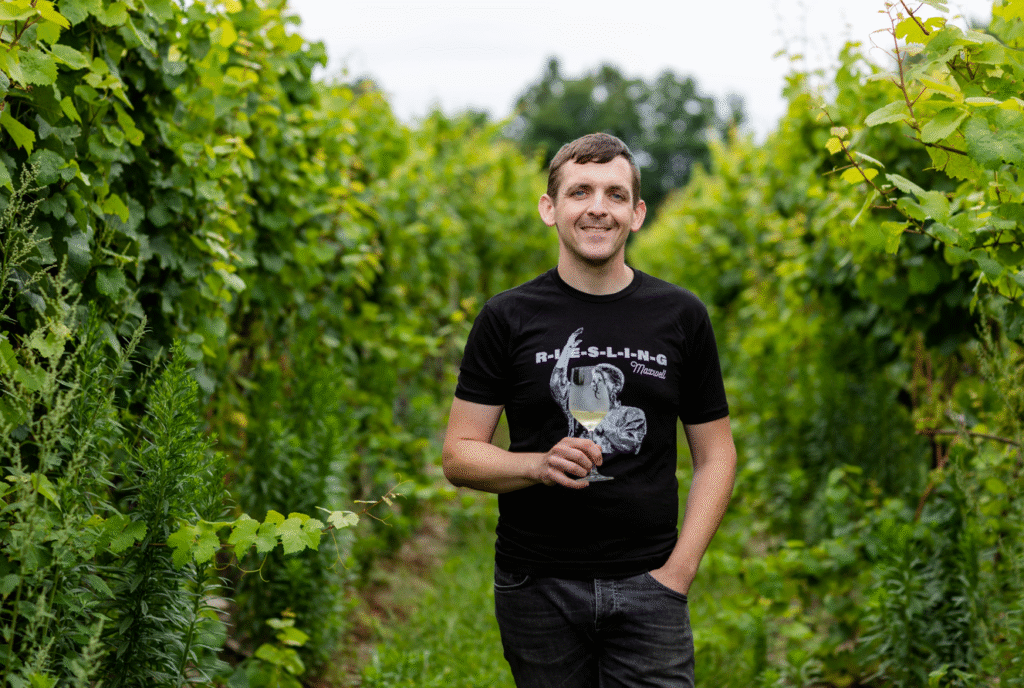
Kelby Russell of Apollo’s Praise
The Google address for Apollo’s Praise on the west side of Seneca Lake says it’s located at the “Driveway at the Barn” before giving its street address. That’s appropriate for this winery, with a short history dating back only to 2022.
Co-owner Kelby Russell, whose partner in the winery is Julia Hoyle, the current winemaker at Hosmer Winery, says they weren’t looking to buy a winery.
“In the summer of 2022, I called a grower that I had worked with at Red Newt and asked if he had any Chardonnay I could buy that year,” says Russell. “He said the Chard was sold out, but asked if I’d like to buy the farm instead. That’s not how that convo usually goes.”
He and Hoyle (the pair are married) were fascinated by the opportunity. The owner, who had strictly been a grower, wanted the farm to go to someone who would take care of it and take it to the next level. They bought the vineyard, and Apollo’s Praise was born.
“We thought I’d keep my job at Red Newt, and Julia would keep hers at Hosmer, and we’d sell the fruit,” Russell says. But after they closed on the farm in April of 2022, the region had its first spring frost in 20 years, and they lost half their first crop. They had to quickly come up with something they could do so they could still make the mortgage. He left Red Newt and started making wine from part of that first crop, and they sold the rest.
Russell certainly calls on some of the heritage of the Finger Lakes when making his wines, but with Apollo’s Praise, they’re also calling on the heritage of the wine world at large.
Because everything happened so fast, they didn’t have time or labor to create a tasting room.
“We pursue distribution and try to get it across the country,” he says. “And we built a wine club. It feels unique, but if you look around the vinous world, it’s not unique at all. One of our formative memories was when we eloped and did our honeymoon in Alsace.”
The couple was amazed that at these great French wineries, you could taste wine not in a fancy tasting room but in a front parlour. They enjoyed the intimacy of it and are embracing that intimacy at Apollo’s Praise.
When the weather allows, they do tastings in their unheated barn. In the winter, they do tastings in their farmhouse with a reservation. While tasting, guests can try the wine that Russell believes bridges that gap between heritage and innovation at Apollo’s Praise.
“The Knoll, our prestige cuvèe dry Riesling, is our showpiece Riesling,” he says. The wine is produced with a technique he began using in 2013 that he borrowed from German producers— making a powerful dry Riesling with structure and weight by crushing, macerating overnight, and then pressing it off, something that was unheard of at that time in the Finger Lakes.
“The more extracted, dry, powerful Riesling is also a nod to a single hill inside the vineyard. It speaks to heritage,” says Russell.
Perhaps innovation and heritage aren’t as at odds with each other as they may seem when it comes to making wine in New York. As the state’s wine industry embraces its bold future, winemakers will continue to call on them both to make great wine.