
New York has been making great wine for centuries.
The first wine grapes were planted here in the mid-1600s by Dutch settlers, and while those initial plantings didn’t thrive at first, there were successful plantings established in the Hudson Valley by the 1670s.
The first commercial plantings of wine grapes happened in the Finger Lakes in 1829, and since then, the reputation of the wines made across the state, from bright and energetic Rieslings in the Finger Lakes to earthy and fruit-forward reds of Long Island, has been toasted by anyone lucky enough to encounter them.
The keyword being “lucky.” Because New York’s mighty terroir and the quality of its wine are not necessarily matched by the quantity of its product. Currently, there are about 29,586 acres of grapes under vine here, compared with California’s 477,475 acres.
But in the past decade, the number of licensed wineries in New York has surged, from 285 to 513. And those winemakers are increasingly eager to share their wines abroad. Thanks to a flurry of recent accolades, most notably Wine Enthusiast naming the Finger Lakes as Wine Region of the Year, the world is equally eager to receive their wares.
The New York Wine & Grape Foundation (NYWGF) recently announced the expansion of its Export Program to the Caribbean, its sixth international market. The Caribbean joins Western Europe, Japan, South Korea, Vietnam, and Canada.

Think Local, Go Global
Mario Mazza, VP and general manager at Mazza Brands in the Lake Erie AVA, explains that their push globally in many ways reflects the way they’ve grown their business domestically, with a few adjustments.
“We are distributed across several U.S. markets,” Mazza says. “We focus on regional partnerships, consumer outreach, and education.”
Mazza started investing in the wholesale side of the business in 2018, and although the pandemic and other market headwinds intervened, they’ve been able to grow their distribution across the Northeast.
“We pursued exports to explore additional sales channels,” Mazza says. “That exploration quickly revealed a broader opportunity: global consumers are actively seeking products that can speak to a younger demographic, especially those offering new flavor profiles from emerging regions.”
This realization prompted Mazza to reflect on the way they present their wines on the global stage, and inspired them to create a direct-to-consumer (DTC) program for the E.U. Their DTC program in the U.S. is a small but important part of their overall sales, and it looks like the DTC model in the E.U. will perform a similar function. Currently, Mazza is available DTC in Scandinavia, France, Germany, the Netherlands, and Switzerland.
Even more than the increase in sales, Mazza says he is happy to see the acclaim the wines have received abroad.
“One of our proudest achievements has been the recognition of our Perfect Rosé, which was listed as the top-scoring Rosé in the U.S. by the Decanter World Wine Awards for two consecutive years,” he says, crediting that accolade with some of the traction and recognition the brand has received.
But navigating regulatory complexities and effectively educating foreign buyers about New York wines’ distinct charms is no easy task.
“New York wines are increasingly seen as high-quality and distinctive, though there’s still work to be done in shaping global perception,” Mazza says. “We focus on storytelling, terroir, and sustainability to differentiate our offerings. International engagement has helped us refine how we present our region’s wines and validate their quality on a global scale.”
Finding a Larger Stage
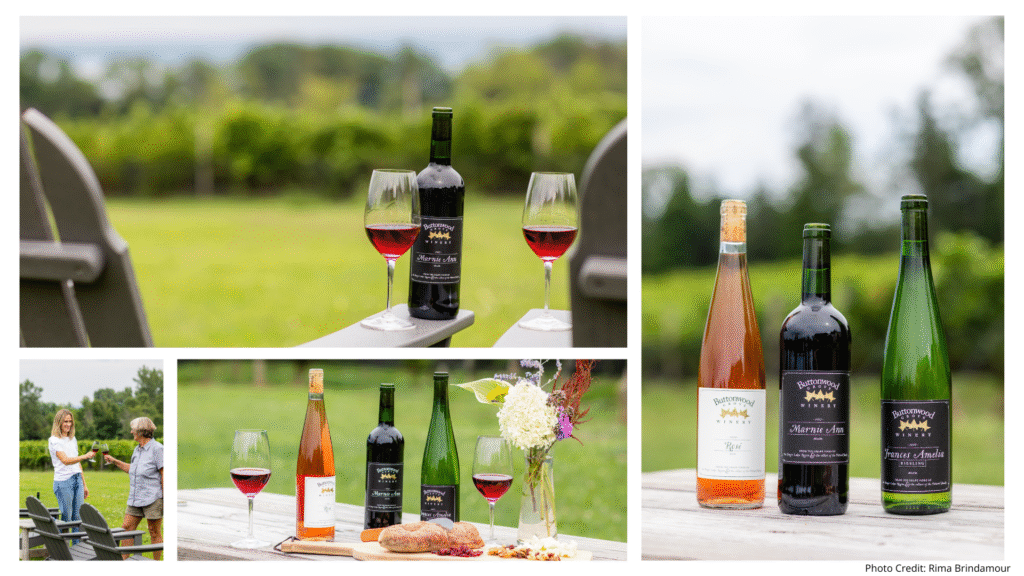
At Buttonwood Grove Winery and sister winery Six Eighty Cellars in the Finger Lakes, wholesale sales manager Jenna Coppola says their desire to engage with a wider range of palates and people pushed them abroad. Buttonwood’s domestic wholesale program started in 2017, and they launched distribution domestically in 2019. Six Eighty’s wholesale program started in 2021; they launched in distribution domestically in 2022.
“We began to export to Norway this year for Buttonwood,” Coppola says. “Six Eighty began exporting to Canada in 2024 and found great success there. Unfortunately, that run was cut too short.”
Coppola says that despite the challenges, she’s bullish on the future of both brands abroad.
“We believe the differing styles of wine we produce between our brands, as well as our philosophies behind production, grant us space on a larger stage and a broader scope of reach than just to domestic consumers,” she says. “With the current landscape of the industry changing by the minute due to tariffs and shifts in consumer interest, we feel that there’s a diverse opportunity due to the quality and value of our wide array of wines outside of our own backyard.”
The wineries are also driven by a desire to quench the thirst for New York wines abroad.
“Interest will continue to grow as New York wines fight to share their place on the main stage and finally have their breakthrough moment,” she says. “We find there to be particular interest in Western Europe, the Nordics specifically, and some interest in areas of Southeast Asia.”
New York Wines Continue to Expand
The Caribbean and its lifestyle and food are a particularly auspicious pairing for New York wine.
“The Caribbean represents an exciting opportunity for New York wines,” says Kyle Anne Pallischeck, Director of Programs for the NYWGF. “The region’s thriving tourism sector and growing domestic appreciation for fine wines create natural markets for our cool-climate offerings. New York’s wines—with their naturally higher acidity and moderate alcohol levels—pair beautifully with Caribbean cuisines and are especially well-suited to warm tropical climates.”
The next time you’re under a palm tree on a tropical Caribbean escape, you may just find yourself swapping a Pina Colada for a New York wine.
About the New York Wines Export Program
For several years, the NYWGF has conducted an exciting Export Program with funding support from the United States Department of Agriculture’s Foreign Agricultural Service (FAS). The New York wines staff team, with the guidance of our Promotions Committee, Market Consultants, and Export Advisory Committee (made up of industry members) execute this program each year. The program year runs from July 1 – June 30.
The New York Wines Export Program provides data, logistical resources, target market education, access to consultants in the field, and market activities like trade missions and large-scale trade shows. The principal activities include New York Wines trade exhibits at major trade shows and consumer events; New York wine seminars with Master Sommeliers and key influencers in each market, publication of brochures and other literature; advertising and public relations; familiarization tours of New York’s wine regions for the press and trade; comprehensive educational resources such as the New York Wine Course & Reference; and meetings with key wine buyers.